
Blockchain vs Database: Why “Distributed” Changes Everything
2026.04.22
I. From “Who Owns the Data” to “Who Verifies It”
At first glance, blockchain and database sound similar — both store information, both record transactions, and both can be queried by users.
But they were built for entirely different purposes.
A traditional database is designed to store and manage data efficiently under one entity’s control.
A blockchain is designed to ensure data integrity and public verifiability without needing to trust that entity at all.
So the question shifts from:
“Who holds the data?”
to
“Who ensures it’s true?”
That shift — from ownership to consensus — is the philosophical heart of blockchain.
II. The Architecture: Centralized vs. Distributed
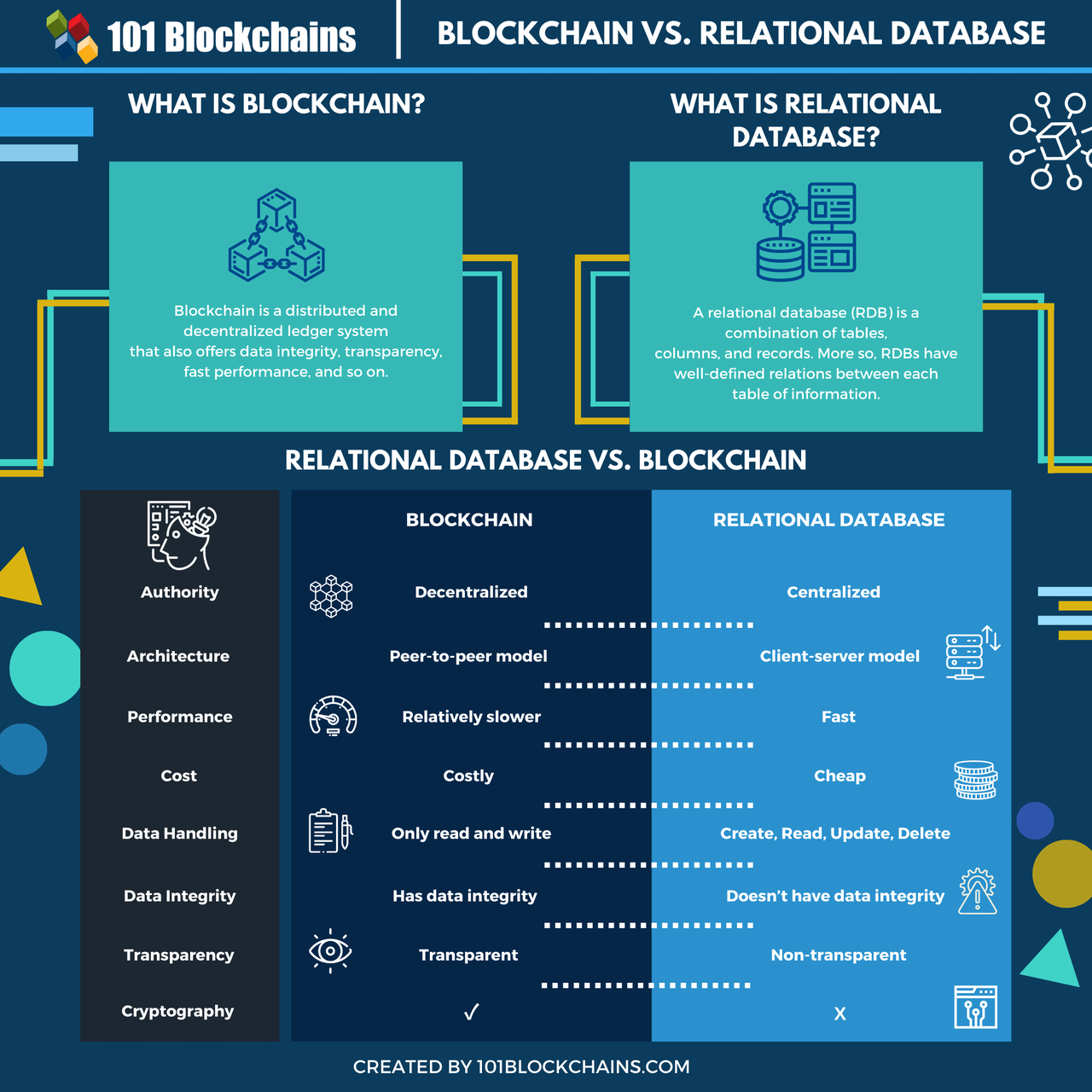
| Category | Traditional Database | Blockchain |
| Control | Managed by a central authority (e.g., bank, company) | Shared by all participants (nodes) |
| Data Storage | Stored on one or several company-owned servers | Copied across thousands of nodes worldwide |
| Data Updates | Admins can modify or delete records | Once confirmed, data is immutable |
| Verification | Internal system checks | Consensus between independent nodes |
| Single Point of Failure | Yes — system crash or corruption | No — every node holds a full backup |
| Trust Source | Institutional | Mathematical |
Think of it this way:
A database is like a private Excel sheet owned by one company.
Blockchain is like a shared Google Sheet that anyone can verify, but no one can secretly edit.
III. The Flow of Trust
In a centralized system, trust flows upward.
- Users trust the administrator.
- The administrator trusts the database.
- The database trusts its backup and security rules.
In a blockchain system, trust flows sideways.
- Each node independently verifies the data.
- Consensus ensures that the majority agree before anything is added.
- There’s no single “root authority” that can rewrite history.
This model doesn’t just store data — it democratizes verification.
IV. How Updates Work
Let’s look at a simple example:
Alice sends 1 BTC to Bob.
In a Database:
- The transaction is written to one server (say, a bank’s ledger).
- The admin updates Alice’s balance (-1) and Bob’s (+1).
- The database trusts the admin’s action — no one else can see the raw record.
In a Blockchain:
- The transaction is broadcast to all nodes.
- Each node checks validity — is Alice’s signature valid? Does she have enough BTC?
- When enough nodes confirm, the transaction is added to a new block.
- That block is linked to all previous ones by cryptographic hash.
- Every node updates its copy simultaneously.
Result: no admin, no hidden edits — and everyone has the same “truth.”
V. Immutability vs. Editability
Traditional databases are mutable —
admins can update, delete, or rewrite data for convenience or correction.
This is both a feature and a risk:
- ✅ It allows fast fixes.
- ⚠️ It enables hidden manipulation.
Blockchain, by contrast, is append-only:
New information can be added, but not silently changed.
If something wrong happens, the fix must be added transparently as a new transaction — preserving the full audit trail.
That’s why in blockchain systems, history is not rewritten; it is extended.
VI. Performance Trade-offs
Let’s be honest — blockchains aren’t “better” at everything.
They trade speed and efficiency for transparency and security.
| Aspect | Traditional Database | Blockchain |
| Speed | Extremely fast (milliseconds) | Slower (requires global consensus) |
| Cost | Low (local servers) | Higher (gas fees, computation) |
| Privacy | High (private records) | Public by default |
| Transparency | Low (depends on access rights) | High (anyone can verify) |
| Fault Tolerance | Moderate | Very high |
In finance or supply chain systems where trust is critical, these trade-offs make sense.
For internal HR systems or small apps, a normal database remains more practical.
VII. Consensus: The Missing Piece in Databases
A database assumes its admin is honest.
A blockchain proves honesty through consensus.
This is what makes blockchain revolutionary.
In Databases:
The database accepts what the admin writes — even if it’s wrong.
In Blockchains:
Every node validates a transaction using agreed-upon rules (the protocol).
Only when most nodes agree does it become part of the chain.
Different blockchains use different methods to reach agreement:
- Proof of Work (PoW): Used by Bitcoin — relies on computational power.
- Proof of Stake (PoS): Used by Ethereum — relies on staked capital.
- Other models: Delegated Proof of Stake (DPoS), Practical Byzantine Fault Tolerance (PBFT), etc.
Consensus makes trust measurable — not subjective.
VIII. Transparency and Auditability
Blockchain turns trust into verifiability.
Every transaction is time-stamped, signed, and stored publicly.
You can always trace:
- Who sent what
- When it happened
- Which block confirmed it
This makes blockchain ideal for:
- Financial transactions
- Supply chain tracking
- Governance and voting systems
- Auditable charity or fund management
While databases can log actions, their logs can also be deleted or rewritten.
Blockchain’s ledger, once written, becomes a shared truth.
IX. Real-World Analogy
Imagine two companies keeping records of gold trades.
Company A (Database):
- Uses a private Excel file.
- One employee can change numbers “to fix errors.”
- Only the company sees the data.
Company B (Blockchain):
- Uses a public blockchain ledger.
- Every trade is confirmed by the network.
- Anyone can verify the record of ownership.
Now — which company would you trust to prove the gold exists?
- That’s the power of verifiable transparency.
X. The Philosophical Shift: From Trust to Proof
Traditional databases rely on trust in authority.
Blockchain relies on proof by code.
This marks the beginning of what technologists call “verifiable computing” —
a world where systems don’t ask for your belief; they offer you mathematical evidence.
Databases say: “Believe us, we recorded it.”
Blockchain says: “Don’t believe us — check for yourself.”
That is why the phrase “Don’t trust, verify” became a Bitcoin ethos —
and later, the foundation of the entire Web3 movement.
XI. When to Use Each
| Use Case | Best Tool |
| Internal company records | Traditional Database |
| Banking / Fintech apps needing compliance | Hybrid (Database + Chain Audit) |
| Cross-border payments | Blockchain |
| Digital asset ownership (NFTs, tokens) | Blockchain |
| Logistics and tracking | Blockchain |
| Social media or small-scale data systems | Database |
The two aren’t rivals — they complement each other.
Blockchain secures truth; databases organize it.
XII. Echobit Learn Takeaway
Blockchain doesn’t replace databases.
It redefines their trust model.
In the Web2 world, platforms own data.
In the Web3 world, users co-own truth.
That’s the key distinction every newcomer must understand.
At Echobit, our mission is to help users cross that line —
from trusting platforms to verifying on-chain.
Blockchain is not just a database upgrade —
it’s a social upgrade for how we record, agree, and believe.